
You've probably used an AI assistant before — asked it a question, got an answer, moved on. But lately, you keep hearing about AI agents, and suddenly the line between the two feels blurry. Are they the same thing with different names? Not even close.
This breakdown is for anyone trying to make sense of the AI tools hitting the market right now — whether you're a business owner figuring out what to adopt, a developer building with these tools, or just someone who wants to stop nodding along when people throw these terms around.
Here's what we'll cover:
- What actually separates an AI agent from an AI assistant — the definitions are simpler than you think, but the gap between them is bigger than most people realize
- How each one works in the real world — with concrete AI agent examples and assistant use cases that make the difference click
- When to use one over the other — and why picking the wrong one for your situation can slow you down instead of speeding things up
By the end, you'll know exactly what you're dealing with — and what makes sense for what you're trying to do.
Understanding the Core Definitions
What AI Assistants Are Designed to Do
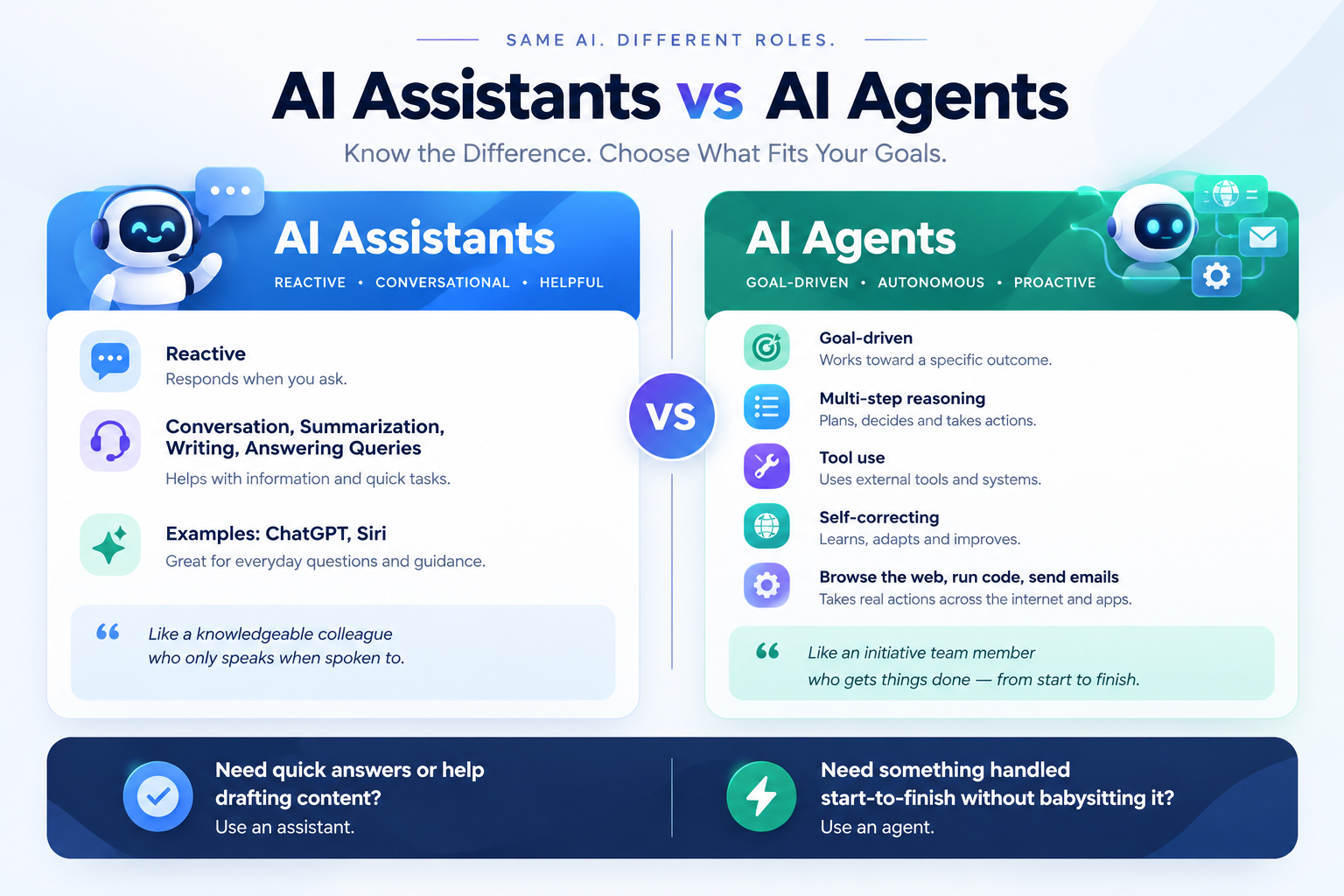
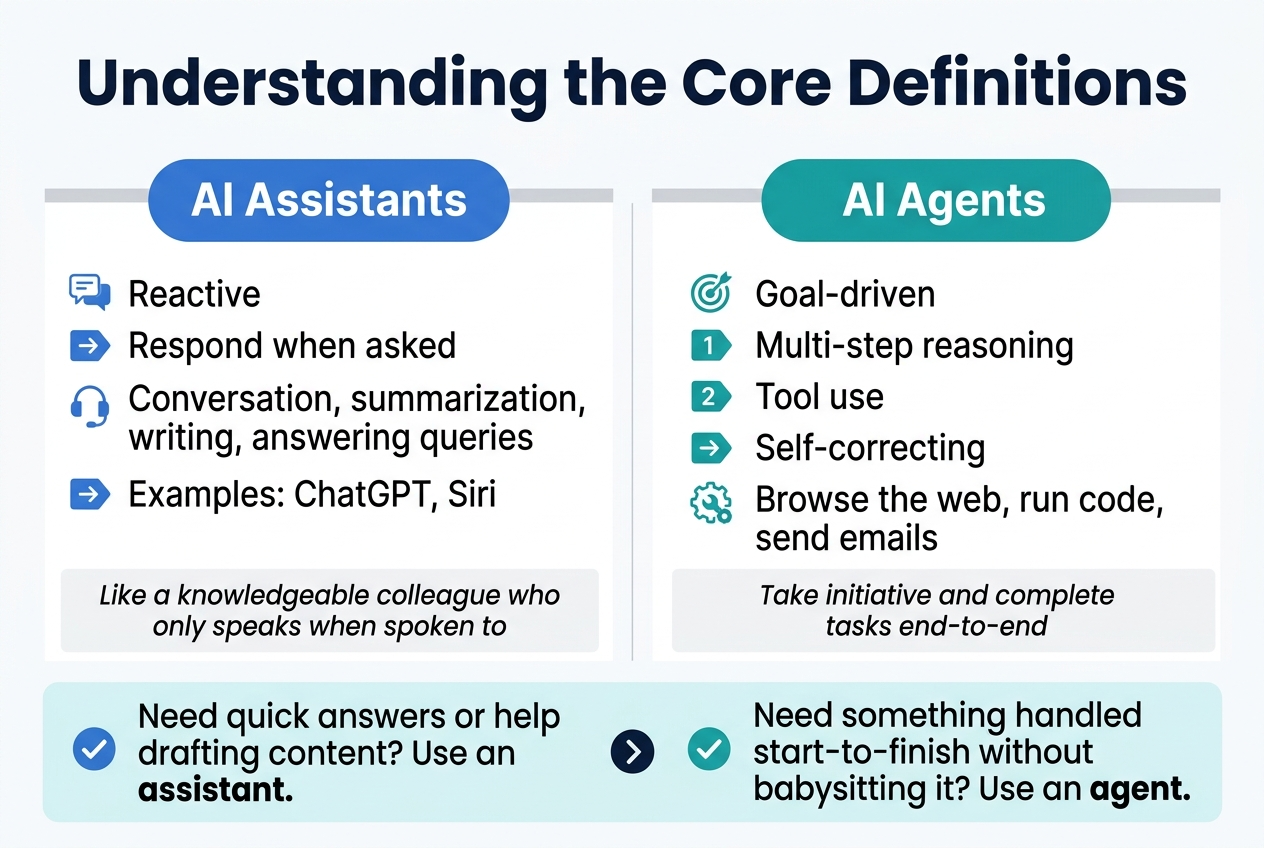
AI assistants are built to respond. Ask a question, get an answer. Request a draft, receive one. Tools like ChatGPT or Siri sit on standby, waiting for your input before doing anything. They're reactive by nature — skilled at conversation, summarization, writing, and answering queries, but only when you initiate.
Think of them as a very knowledgeable colleague who only speaks when spoken to.
What AI Agents Are Built to Achieve
AI agents operate differently — they take initiative. Rather than waiting for prompts, they pursue goals across multiple steps, making decisions and adjusting as they go. An autonomous AI agent can browse the web, run code, send emails, and complete tasks end-to-end without you guiding every move.
Key characteristics of AI agents:
- Goal-driven — work toward an outcome, not just a single response
- Multi-step reasoning — break down complex tasks independently
- Tool use — interact with external apps, APIs, and environments
- Self-correcting — adapt when something doesn't go as planned
Why the Distinction Matters for Everyday Users
Understanding the difference between AI agents and assistants helps you pick the right tool. Need quick answers or help drafting content? An assistant works perfectly. Need something handled start-to-finish without babysitting it? That's where agents shine.
Key Differences in How They Operate
Reactive Responses vs. Proactive Goal Execution
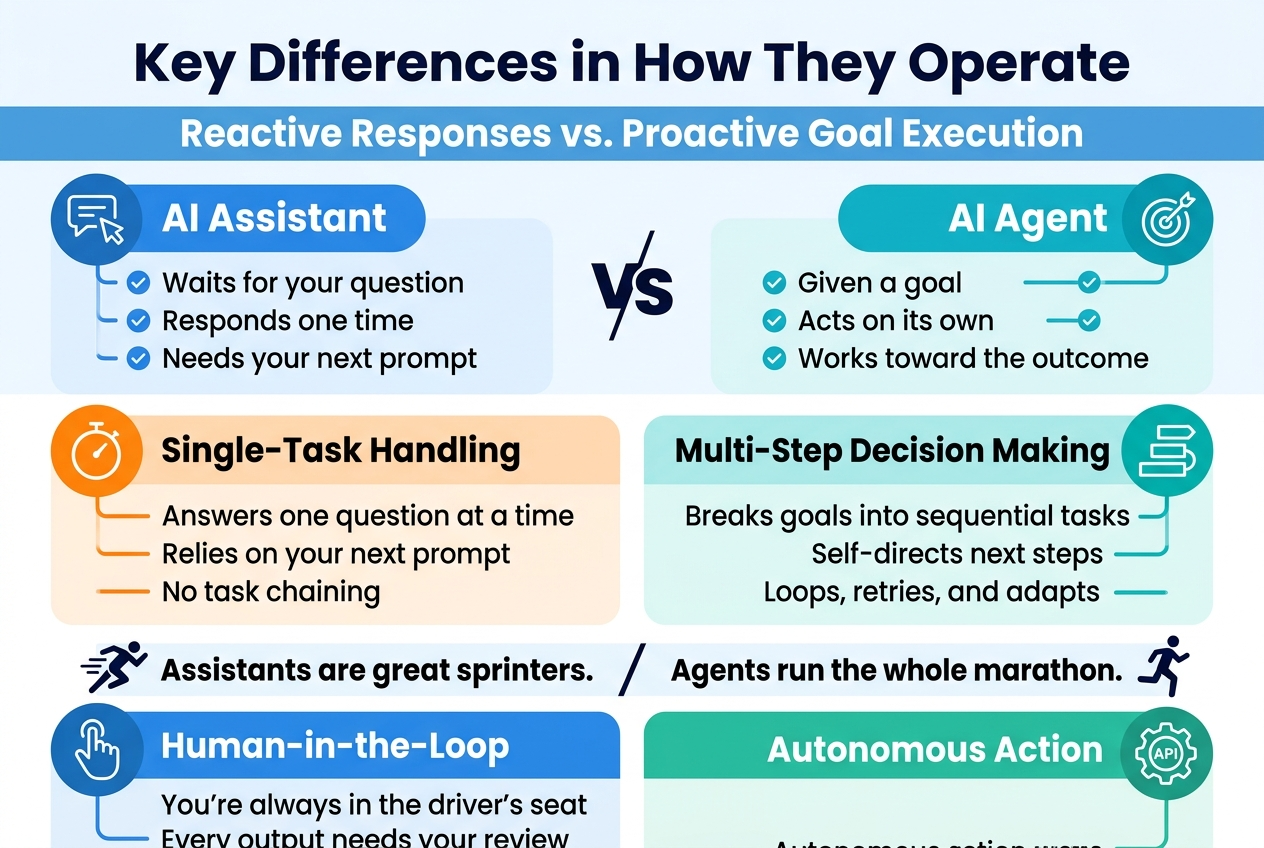
AI assistants wait for you to ask something, then respond. That's it. AI agents flip this dynamic — they're given a goal and actively work toward it, taking steps without needing you to hold their hand through every decision.
Single-Task Handling vs. Multi-Step Decision Making
| AI Assistant | AI Agent |
|---|---|
| Answers one question at a time | Breaks goals into sequential tasks |
| Relies on your next prompt | Self-directs next steps |
| No task chaining | Loops, retries, and adapts |
Assistants are great sprinters. Agents run the whole marathon.
Human-in-the-Loop vs. Autonomous Action
With assistants, you're always in the driver's seat. Every output needs your review before anything moves forward. Autonomous AI agents can make decisions, call APIs, browse the web, or trigger workflows — all without waiting on you. How much autonomy they get depends on how they're configured.
Memory and Context Retention Capabilities
Most AI assistants have short-term memory — forget the chat window, forget the context. AI agents are built differently. They can store past actions, reference previous outcomes, and carry that knowledge into future decisions, making them far more effective at handling long-running, complex tasks.
Real-World Examples That Clarify the Gap
Common AI Assistants You Already Use Daily
You're probably using AI assistants without even thinking about it:
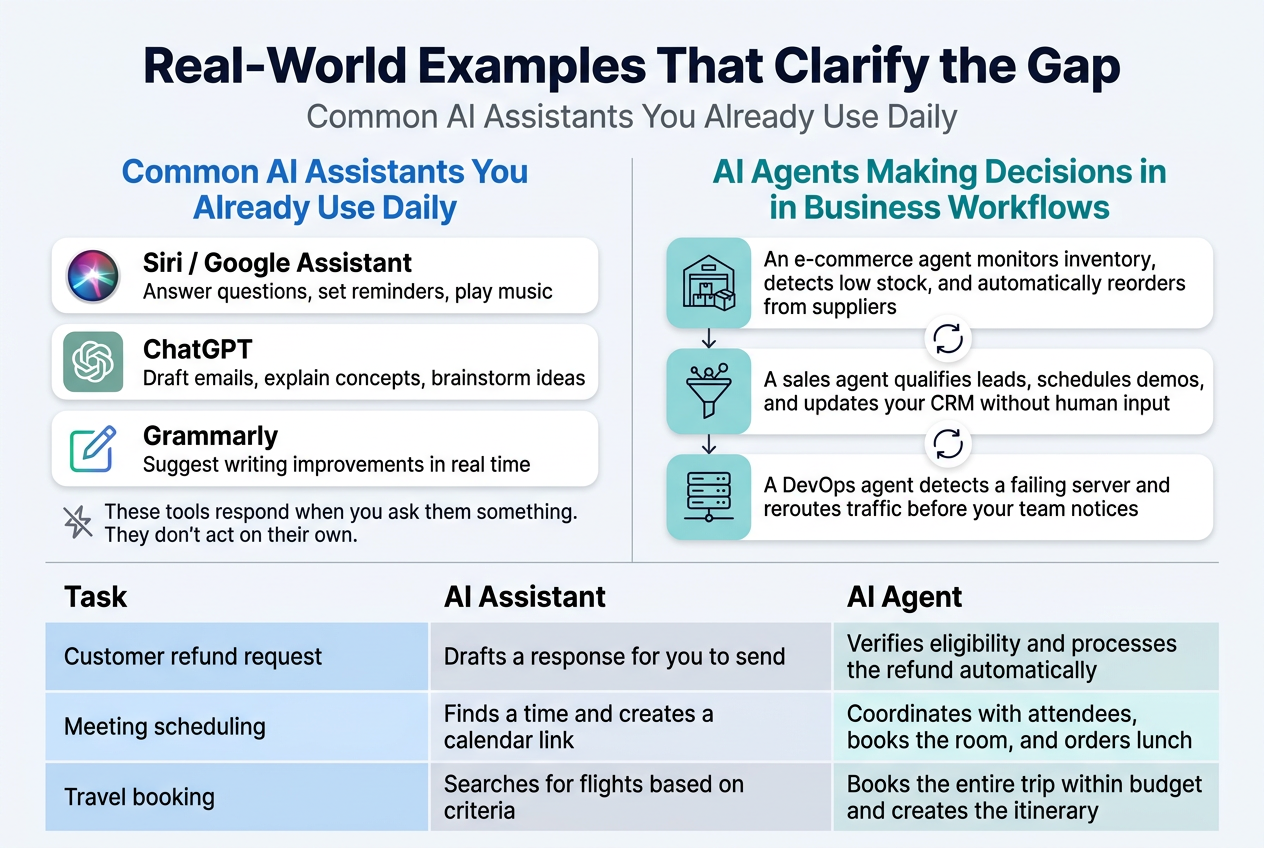
- Siri / Google Assistant – Answer questions, set reminders, play music
- ChatGPT – Draft emails, explain concepts, brainstorm ideas
- Grammarly – Suggest writing improvements in real time
These tools respond when you ask them something. They don't act on their own.
AI Agents Making Decisions in Business Workflows
AI agents operate differently — they're given a goal, not just a prompt:
- An e-commerce agent monitors inventory, detects low stock, and automatically reorders from suppliers
- A sales agent qualifies leads, schedules demos, and updates your CRM without human input
- A DevOps agent detects a failing server and reroutes traffic before your team notices
Side-by-Side Comparison of the Same Task Handled Differently
| Task | AI Assistant | AI Agent |
|---|---|---|
| Customer refund request | Drafts a response for you to send | Verifies order, processes refund, sends confirmation automatically |
| Meeting scheduling | Suggests available times | Books the meeting, invites attendees, adds agenda |
| Data report | Generates a report when asked | Pulls data daily and delivers the report on schedule |
The difference between AI agents and assistants comes down to who acts — you or the AI.
When to Use an AI Assistant vs. an AI Agent
Best Use Cases for AI Assistants
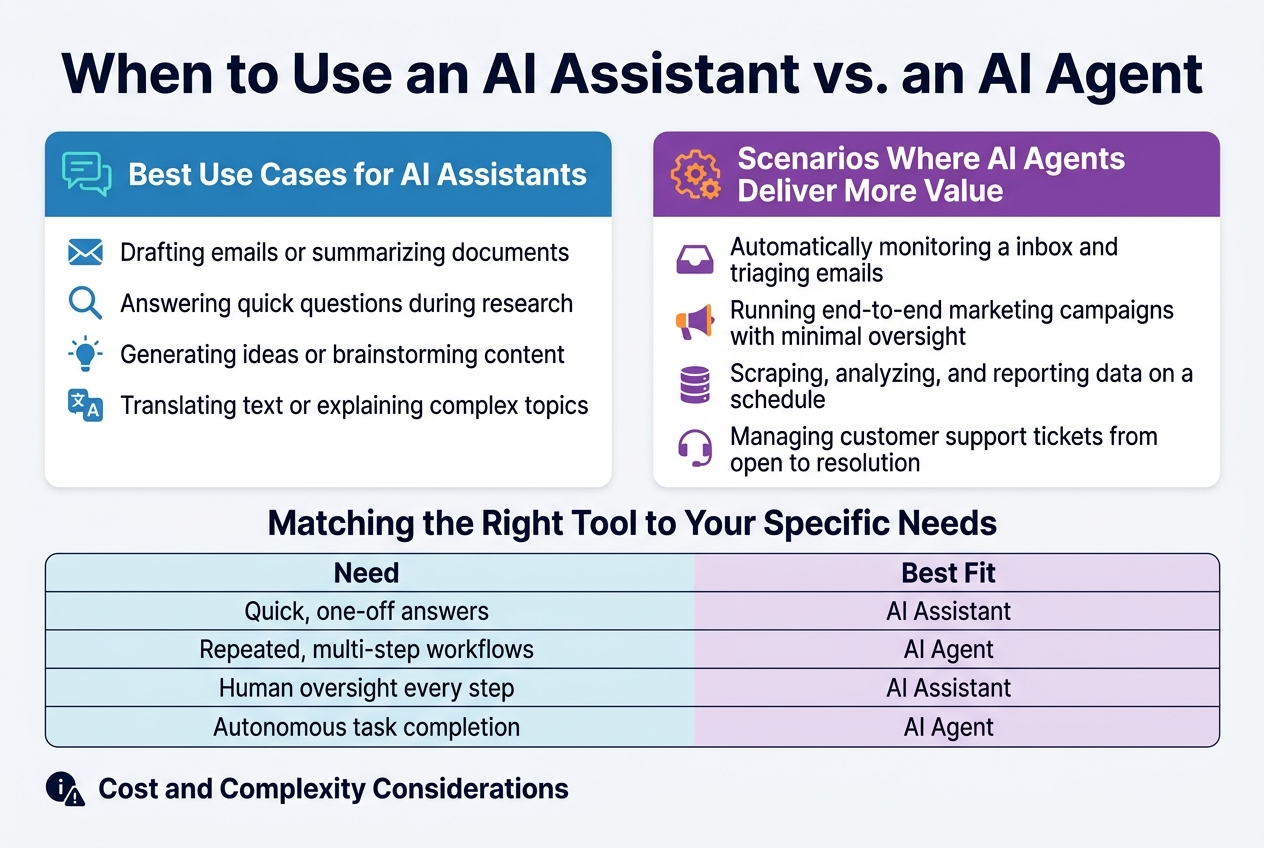
AI assistants shine when tasks are conversational, on-demand, and don't require follow-through:
- Drafting emails or summarizing documents
- Answering quick questions during research
- Generating ideas or brainstorming content
- Translating text or explaining complex topics
Scenarios Where AI Agents Deliver More Value
When to use AI agents becomes clear once multi-step execution is involved:
- Automatically monitoring a inbox and triaging emails
- Running end-to-end marketing campaigns with minimal oversight
- Scraping, analyzing, and reporting data on a schedule
- Managing customer support tickets from open to resolution
Matching the Right Tool to Your Specific Needs
| Need | Best Fit |
|---|---|
| Quick, one-off answers | AI Assistant |
| Repeated, multi-step workflows | AI Agent |
| Human oversight every step | AI Assistant |
| Autonomous task completion | AI Agent |
Cost and Complexity Trade-offs to Consider
Agents require more infrastructure, APIs, and monitoring—which means higher setup costs. Assistants are plug-and-play but need you in the loop constantly.
Questions to Ask Before Choosing a Solution
- Does this task repeat regularly?
- Can I afford mistakes without human review?
- How many tools or systems need to connect?
- What's my technical bandwidth for setup?
How AI Agents and Assistants Work Together
Combining Both Tools for Maximum Productivity
AI agents and assistants aren't competitors — they're teammates. Think of an AI assistant as your sharp, always-available research partner, and an AI agent as the one who actually runs the play. Together, they cover the full spectrum from answering questions to getting things done autonomously.
A practical setup might look like this:
- AI assistant drafts a project brief based on your input
- AI agent breaks that brief into tasks, assigns them, and tracks deadlines without you lifting a finger
Industries Already Benefiting from Hybrid Approaches
| Industry | Assistant Role | Agent Role |
|---|---|---|
| Healthcare | Answer patient FAQs | Schedule appointments, send reminders |
| E-commerce | Product recommendations | Inventory reordering, order tracking |
| Finance | Explain market trends | Execute trades, flag anomalies |
| Marketing | Generate ad copy | A/B test, optimize, and report results |
How to Integrate Both into Your Existing Workflow
Start small:
- Identify repetitive decisions — let an assistant handle information gathering
- Spot recurring tasks — hand those off to an agent
- Connect them through tools like Zapier, Make, or native APIs
The real productivity jump happens when you stop thinking about AI agents vs assistants as a choice and start treating them as a system.
The Future of AI Agents and Assistants
How Autonomy Levels Will Continue to Evolve
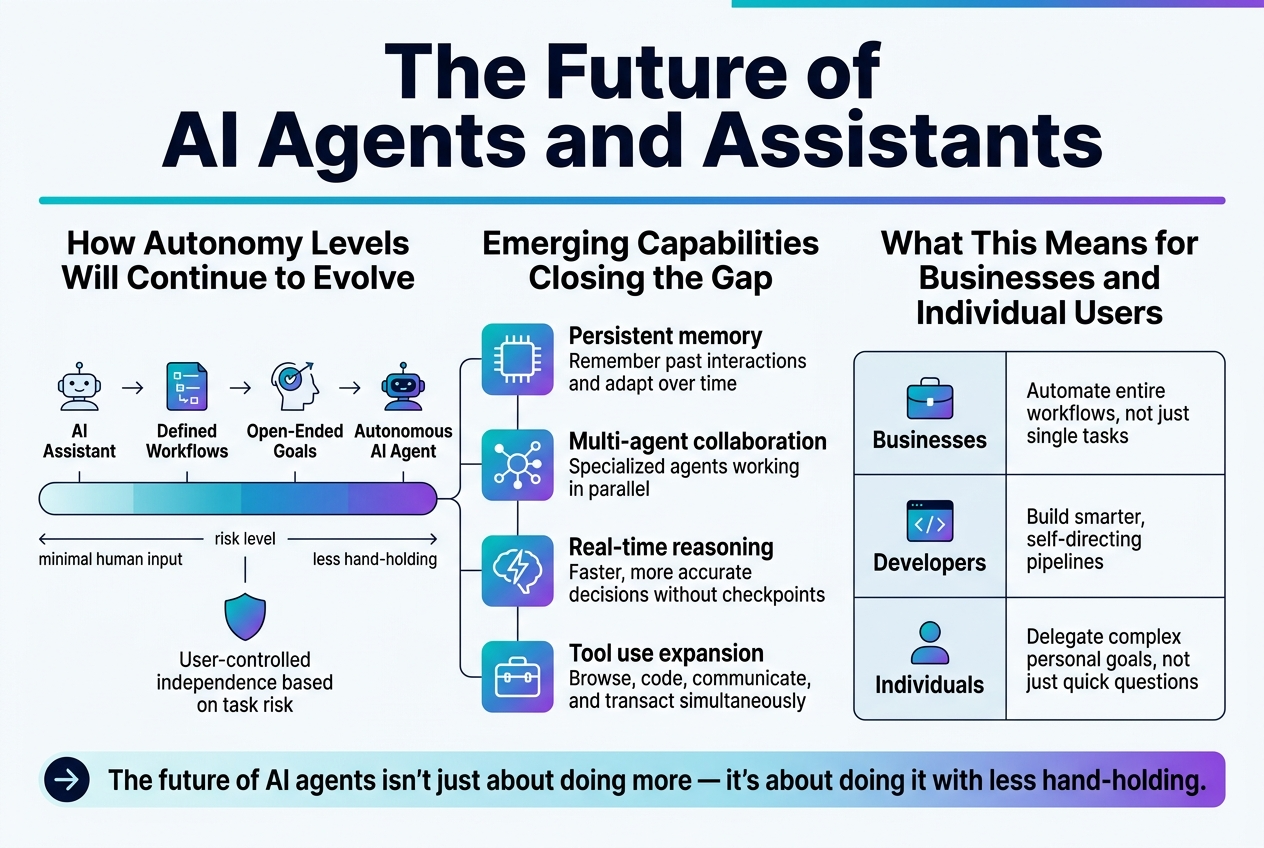
The gap between AI assistants and autonomous AI agents is shrinking fast. Right now, agents handle defined workflows with minimal human input. Soon, they'll manage open-ended goals, self-correct mistakes, and chain together complex decisions across tools and platforms — all without being prompted at every step.
Expect autonomy to move on a sliding scale, where users control how much independence an agent gets based on the task's risk level.
Emerging Capabilities Closing the Gap
Several developments are blurring the line between AI agents and assistants:
- Persistent memory — AI systems that remember past interactions and adapt over time
- Multi-agent collaboration — networks of specialized agents working in parallel
- Real-time reasoning — faster, more accurate decision-making without human checkpoints
- Tool use expansion — agents that can browse, code, communicate, and transact simultaneously
These capabilities mean tomorrow's AI assistants will behave a lot like today's agents.
What This Means for Businesses and Individual Users
| User Type | Key Opportunity |
|---|---|
| Businesses | Automate entire workflows, not just single tasks |
| Developers | Build smarter, self-directing pipelines |
| Individuals | Delegate complex personal goals, not just quick questions |
The future of AI agents isn't just about doing more — it's about doing it with less hand-holding.
Conclusion
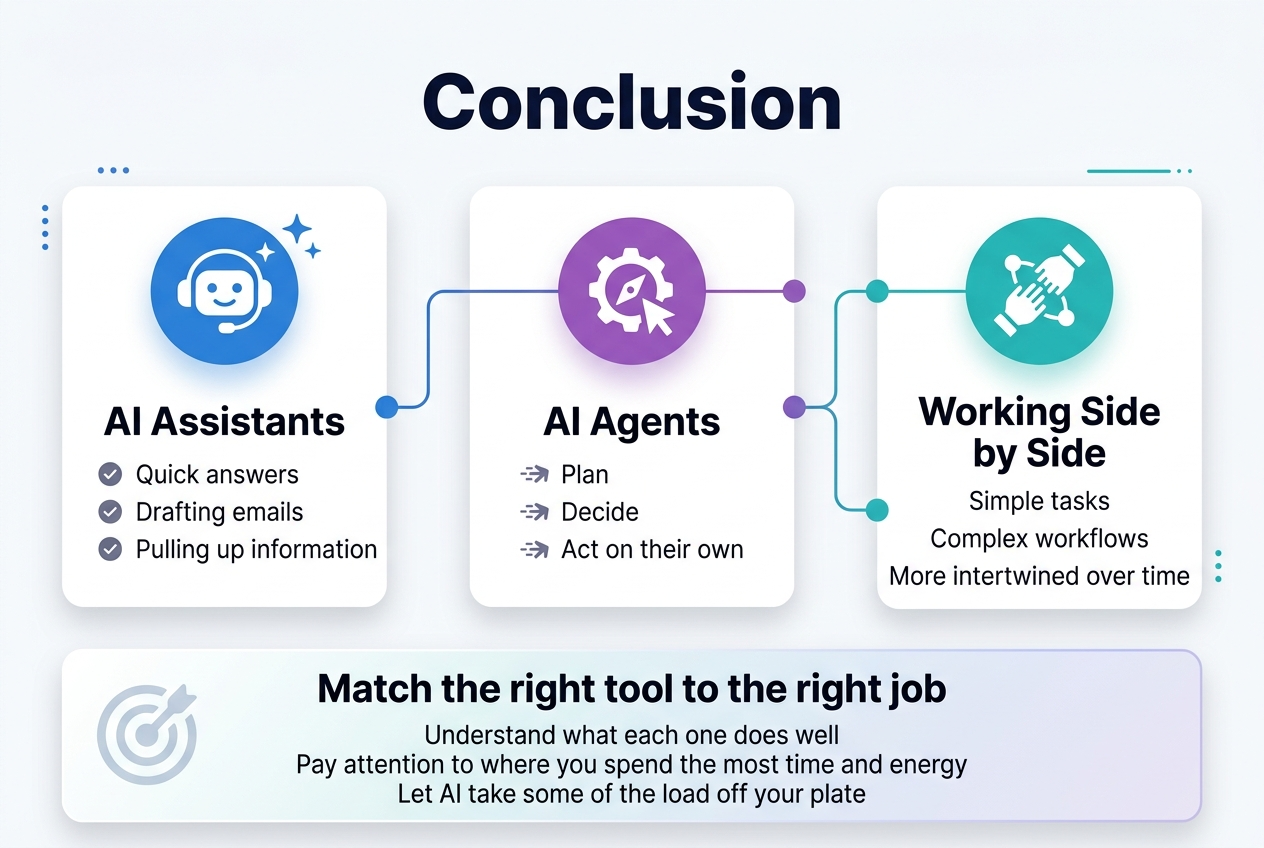
The line between AI assistants and AI agents is getting clearer once you see them in action. Assistants are your go-to for quick answers, drafting emails, or pulling up information when you need it. Agents, on the other hand, take the wheel — they plan, decide, and act on their own to get a job done. Neither is better than the other; they just play different roles depending on what you actually need.
As AI keeps evolving, the two will only get more intertwined, working side by side to handle everything from simple tasks to complex workflows. The smartest move right now is to understand what each one does well and match the right tool to the right job. Start paying attention to where you're spending the most time and energy — chances are, there's an AI assistant or agent that can take some of that off your plate.
Not sure whether your next build needs a simple assistant or a fully autonomous agent? Talk to DotLinker — we design and build both, and we'll help you figure out which one actually fits your workflow.
Not ready to start your project yet?
Talk through your idea with a real engineer, or get a ballpark estimate — both are free.