
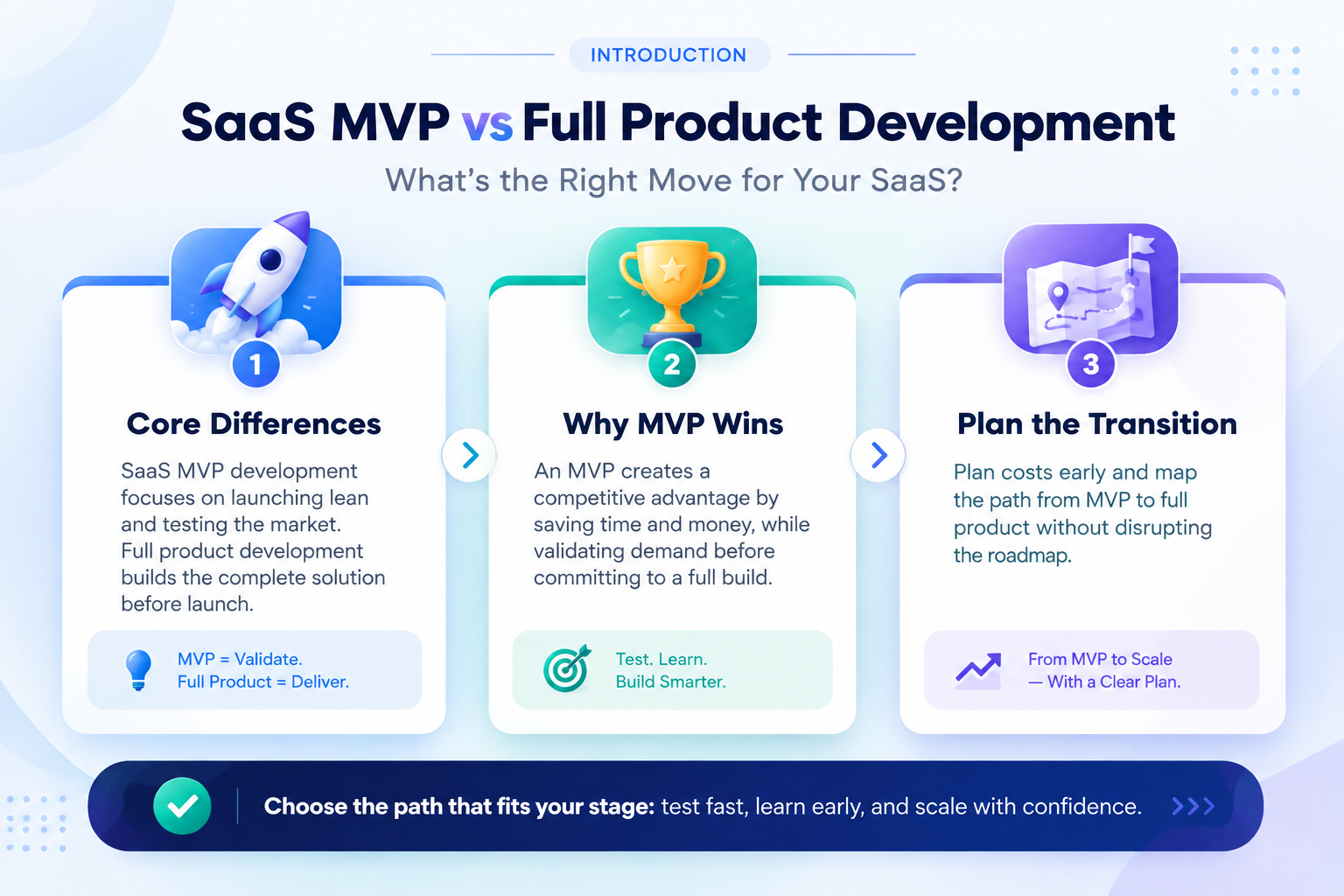
You've got a SaaS idea you believe in. Now comes the real question: do you launch something lean and test the waters, or do you build the whole thing out before going to market?
This decision trips up a lot of founders, product managers, and startup teams — and getting it wrong can cost you months of work and serious money.
This guide is for SaaS builders who are figuring out their SaaS product development strategy from the ground up. Whether you're pre-revenue or preparing for your first launch, what you're about to read will help you make a smarter call.
Here's what we'll cover:
- The core differences between SaaS MVP development and full product development — so you know exactly what you're choosing between
- Why building an MVP gives you a real competitive advantage, and when skipping it might actually make more sense
- How to plan costs and transition your MVP into a full product without throwing your roadmap into chaos
No fluff, no theory for theory's sake — just a straight look at what works, what doesn't, and how to pick the path that fits where you are right now.
Understanding the Core Differences Between MVP and Full Product Development
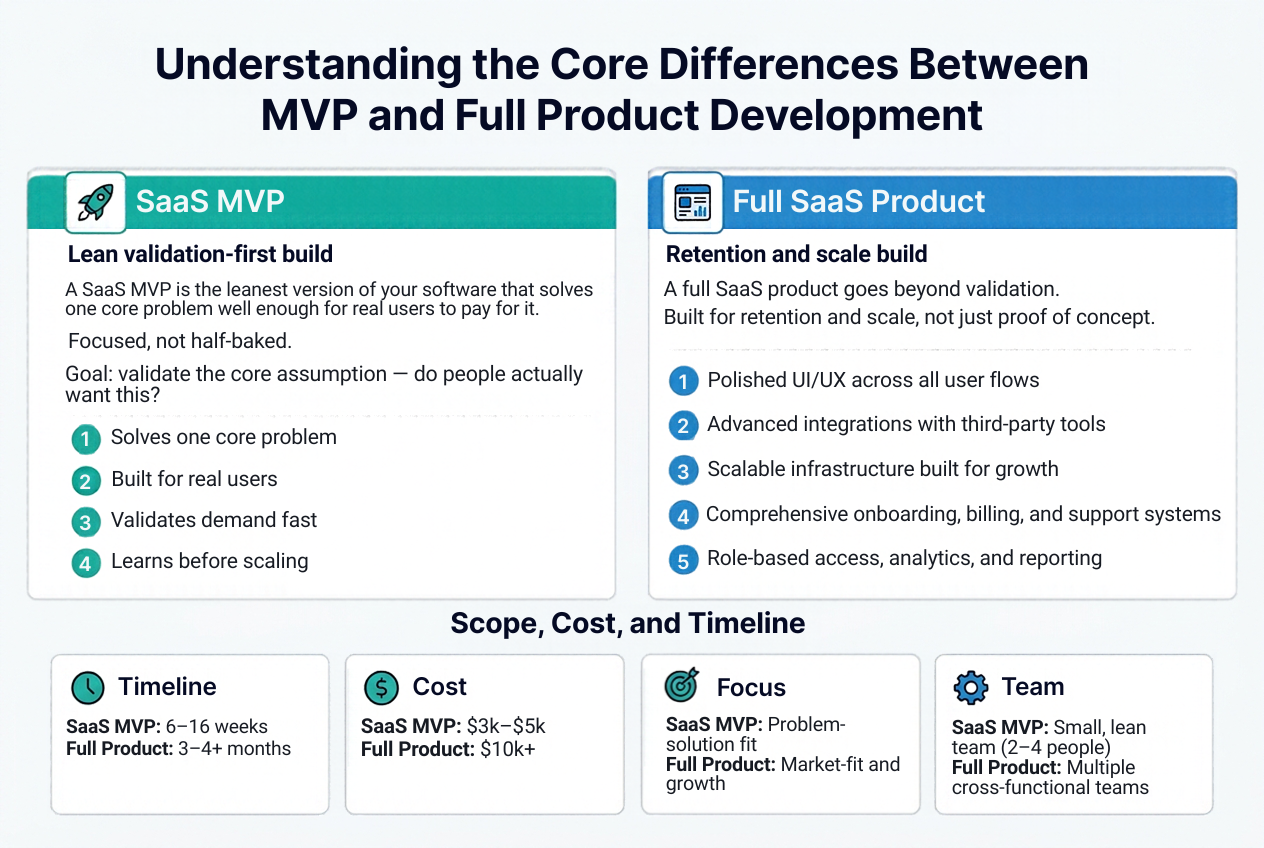
What Defines a SaaS MVP and Why It Matters
A SaaS MVP (minimum viable product) is the leanest version of your software that solves one core problem well enough for real users to pay for it. It's not a half-baked product — it's a focused one. The goal is to validate your core assumption: do people actually want this? before you pour resources into building something nobody asked for.
Key Characteristics of a Full SaaS Product
A full SaaS product goes beyond validation. It includes:
- Polished UI/UX across all user flows
- Advanced integrations with third-party tools
- Scalable infrastructure built for growth
- Comprehensive onboarding, billing, and support systems
- Role-based access, analytics, and reporting
It's built for retention and scale, not just proof of concept.
How Scope, Cost, and Timeline Differ Between the Two Approaches
| Factor | SaaS MVP | Full Product |
|---|---|---|
| Timeline | 6–16 weeks | 3–4+ months |
| Cost | $3K–$5K | $10K+ |
| Features | Core use case only | End-to-end functionality |
| Risk | Low | High without prior validation |
| Goal | Learn fast | Scale confidently |
SaaS product development strategy should always weigh speed-to-learning against long-term build costs.
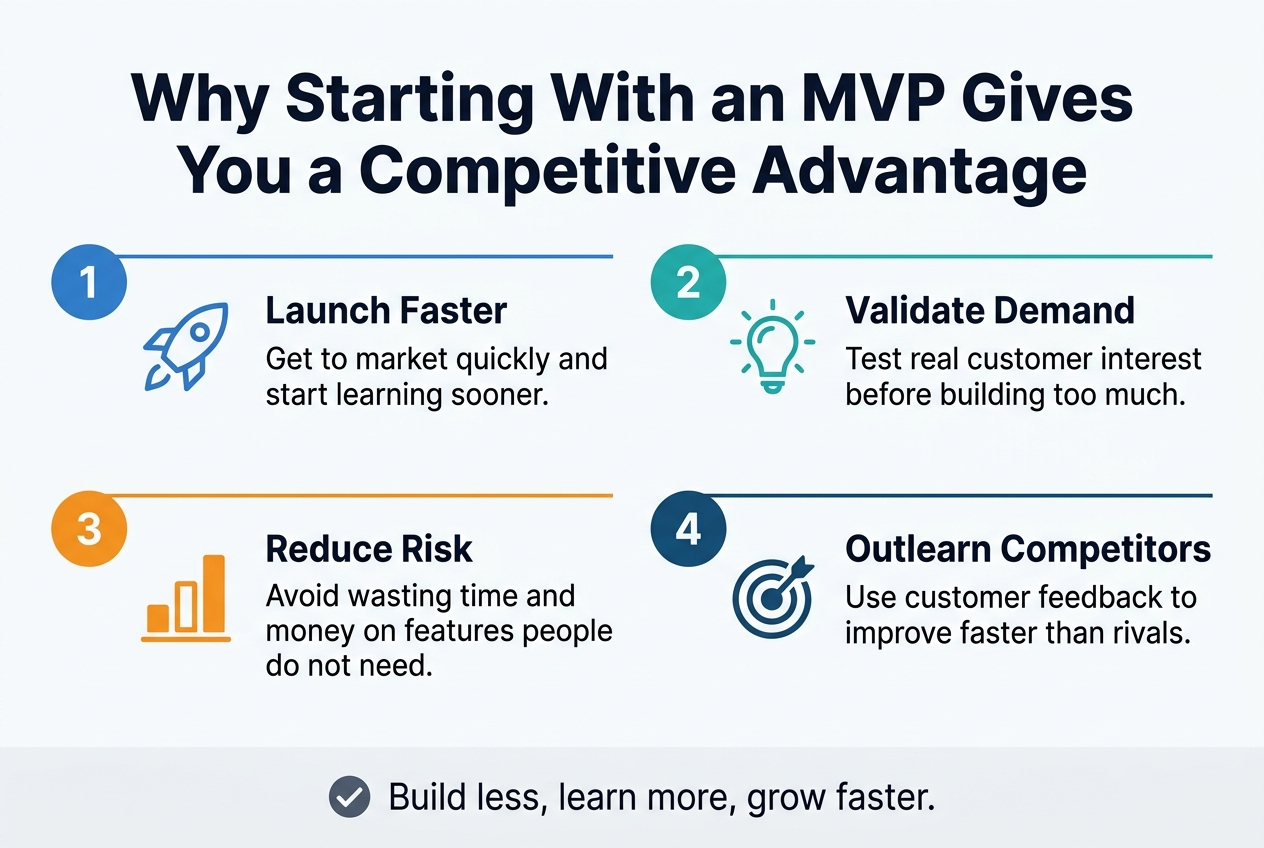
Why Starting With an MVP Gives You a Competitive Advantage
Validate Your Idea Before Committing Major Resources
Spending months and thousands of dollars building a product nobody wants is a painful (and common) mistake. SaaS MVP development lets you test your core assumptions with minimal investment. You build just enough to answer the question: does this solve a real problem people will pay for?
Gather Real User Feedback to Shape Your Product Direction
Real users will surprise you—often in ways no amount of internal brainstorming can predict. Early adopters reveal which features actually matter, which ones they ignore, and what they wish you'd built instead. That feedback becomes your product roadmap, grounded in reality rather than guesswork.
Reduce Financial Risk While Maximizing Learning Opportunities
| Approach | Upfront Cost | Learning Speed | Risk Level |
|---|---|---|---|
| MVP | Low | Fast | Low |
| Full Product | High | Slow | High |
Every dollar saved during early validation is a dollar available when you know what to build. Minimum viable product SaaS strategy keeps your burn rate low while compressing your learning curve significantly.
Reach the Market Faster and Beat Slower Competitors
Speed is a genuine advantage. While competitors are still in development, you're already building an audience, collecting data, and refining your product. That head start compounds quickly and becomes very difficult to overcome.
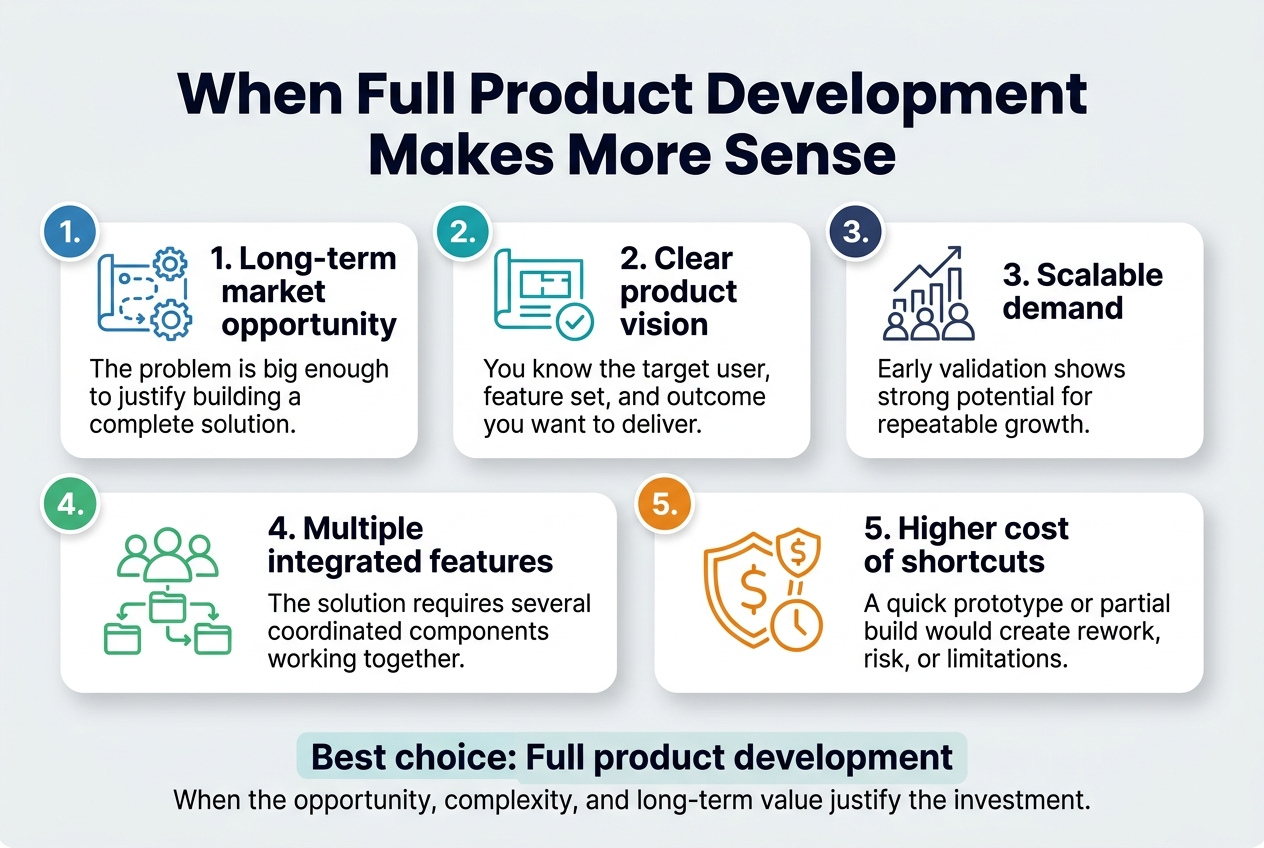
When Full Product Development Makes More Sense
Situations Where a Polished Product Builds Greater Trust
Some markets simply won't tolerate a rough-around-the-edges launch. Enterprise B2B SaaS buyers, for example, run thorough vendor evaluations. A buggy, feature-light product can permanently damage your reputation before you even get a foot in the door.
When your target customers are:
- Large enterprises with procurement committees
- Buyers making high-stakes, long-term commitments
- Markets where competitors already offer mature solutions
…shipping a half-finished product can cost you deals you'll never win back.
Industries Where Compliance Demands a Complete Solution From Day One
Regulated industries leave no room for "we'll add that later." A healthcare SaaS product without HIPAA compliance isn't a work-in-progress — it's a liability. The same applies to:
- Fintech – PCI-DSS, SOC 2, AML requirements
- Healthcare – HIPAA, FDA regulations
- Legal tech – Data sovereignty and client confidentiality laws
Skipping these from launch isn't scrappy; it's a dealbreaker.
How Existing Market Data Can Justify Skipping the MVP Stage
Sometimes the research is already done for you. If validated industry reports, competitor traction, or your own prior product experience clearly confirm demand, an MVP vs full product debate becomes straightforward — go full product, move faster, and capture the market before someone else does.
Essential Features Every SaaS MVP Must Include to Succeed
Focus on the One Core Problem Your Product Solves
Your SaaS MVP needs a razor-sharp focus. Pick the single pain point your target user loses sleep over, and build everything around solving that. Not five problems. One.
Ask yourself: what's the one thing users can't do without your product?
Must-Have Features That Deliver Immediate Value to Early Users
Keep your SaaS MVP features limited but impactful:
- Core functionality — the feature that directly solves the main problem
- Basic onboarding — users should reach their "aha moment" within minutes
- Simple authentication — secure login without unnecessary complexity
- Feedback mechanism — a way for early users to tell you what's broken or missing
What to Intentionally Leave Out to Stay Lean and Focused
Cut these ruthlessly from your first build:
- Advanced reporting and analytics dashboards
- Third-party integrations (beyond one or two critical ones)
- Role-based permissions and admin controls
- Custom branding or white-label options
How to Prioritize Your Feature Roadmap for Future Growth
Use a simple scoring framework:
| Priority Factor | Questions to Ask |
|---|---|
| User demand | How many users requested this? |
| Revenue impact | Does this help convert or retain? |
| Build effort | How long does it take to ship? |
High demand + high revenue impact + low effort = build it next.
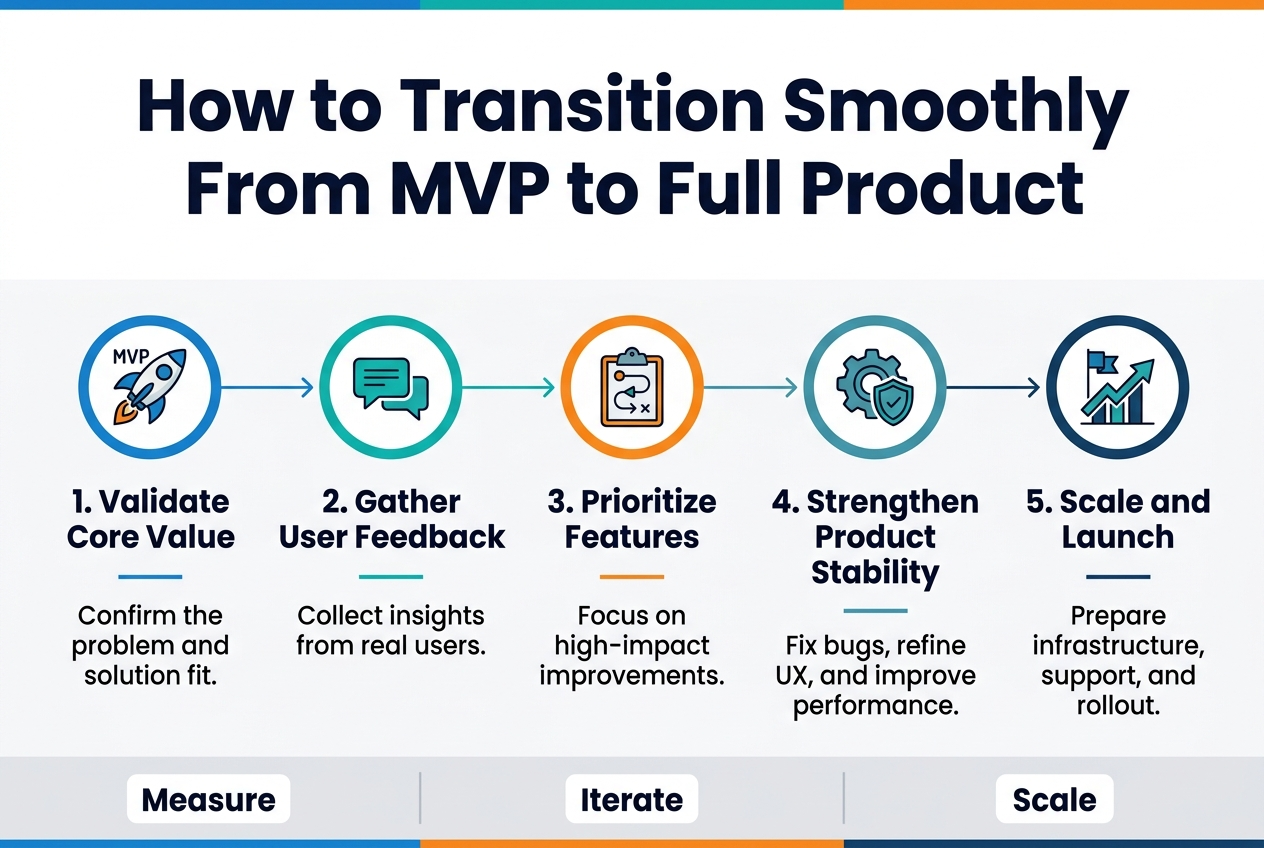
How to Transition Smoothly From MVP to Full Product
Use Early User Data to Guide Your Next Development Phase
Your MVP data is gold. Track which features get used daily, where users drop off, and what support tickets keep repeating. These patterns tell you exactly what to build next — no guesswork needed.
Scale Infrastructure Without Disrupting Existing Customers
Scaling quietly is an art. Use feature flags to roll out changes gradually, run load testing before major releases, and keep a rollback plan ready. Your paying customers shouldn't feel your growing pains.
| Scaling Priority | Approach |
|---|---|
| Database performance | Caching + read replicas |
| Uptime reliability | Auto-scaling + redundancy |
| New feature rollouts | Feature flags + staged releases |
Secure Funding and Stakeholder Buy-In Based on MVP Results
When pitching investors or internal stakeholders, let your MVP numbers do the talking. Show retention rates, MRR growth, and real user testimonials. Concrete traction beats any pitch deck slide.
Build a Product Roadmap That Balances Growth With Stability
Rushing every new feature kills stability. A solid SaaS product development strategy splits your roadmap roughly 60/40 — new features versus technical debt and infrastructure improvements. Ship fast, but keep what's already working rock-solid.
Cost and Resource Planning for Both Development Approaches
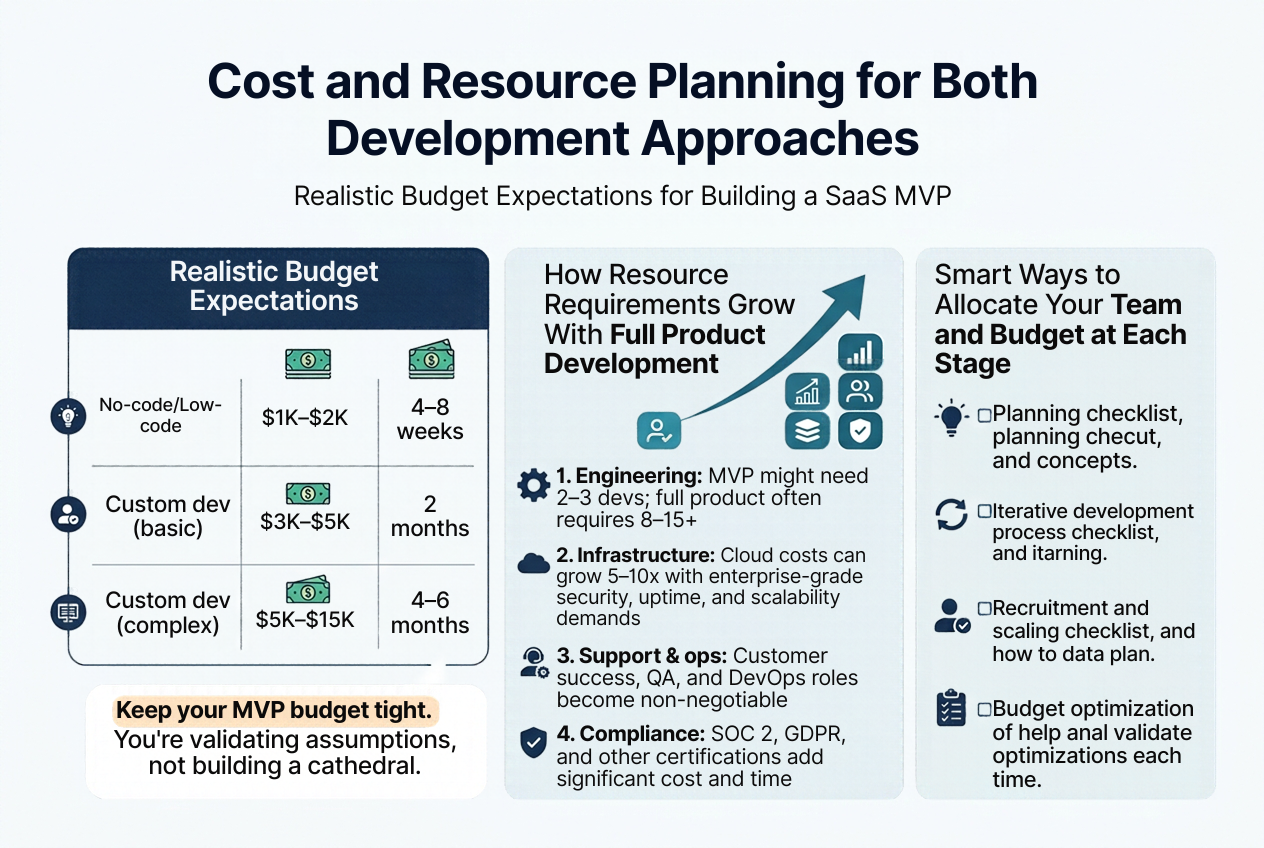
Realistic Budget Expectations for Building a SaaS MVP
SaaS MVP development costs vary widely, but here's a practical breakdown:
| MVP Type | Estimated Cost | Timeline |
|---|---|---|
| No-code/Low-code | $1K–$2K | 4–8 weeks |
| Custom dev (basic) | $3K–$5K | 2 months |
| Custom dev (complex) | $5K–$15K | 4–6 months |
Keep your MVP budget tight. You're validating assumptions, not building a cathedral.
How Resource Requirements Grow With Full Product Development
Scaling to a full product isn't a linear jump — it's a multiplier effect:
- Engineering: MVP might need 2–3 devs; full product often requires 8–15+
- Infrastructure: Cloud costs can grow 5–10x with enterprise-grade security, uptime, and scalability demands
- Support & ops: Customer success, QA, and DevOps roles become non-negotiable
- Compliance: SOC 2, GDPR, and other certifications add significant cost and time
Smart Ways to Allocate Your Team and Budget at Each Stage
- MVP stage: Prioritize engineers and one strong product thinker over large teams
- Post-validation: Reinvest revenue before burning through runway on headcount
- Full product: Hire in response to real bottlenecks, not anticipated ones
- Always: Keep 20–30% of your budget as a buffer — surprises are guaranteed in SaaS product development strategy planning
Conclusion
Choosing between an MVP and full product development isn't about which approach is better — it's about what makes sense for your specific situation. An MVP lets you test your idea quickly, learn from real users, and avoid burning through resources on features nobody wants. Full product development, on the other hand, works better when you already have validated demand, a clear market, and the budget to back it up. Getting the cost and resource planning right from the start makes a huge difference in how smoothly either path goes.
If you're just starting out, lean toward the MVP route. Build only what solves the core problem, get it in front of real users, and let their feedback shape what comes next. The goal isn't to launch something perfect — it's to launch something that works well enough to prove your idea has legs. From there, growing into a full product feels a lot less risky and a lot more intentional.
Have a SaaS idea and not sure whether to start lean or build the whole thing? Talk to DotLinker — we build both, and we'll help you figure out which path fits your stage.
Not ready to start your project yet?
Talk through your idea with a real engineer, or get a ballpark estimate — both are free.